
Chen Dongsheng: Strategy decides everything
2024-03-18
Tang Zhenzhi: Huizhi Enterprise Special Forces from Tanggula Mountain Military Station
2024-03-19Author: Kilimanjaro's Snow
Source: Earth Knowledge Bureau (ID: diqiuzhishiju)
In recent years, Vietnam has been the "meat and potatoes" of both the European and American markets as well as the court of public opinion, and has gained a strong public opinion position at the economic level.
In fact, in addition to Europe and the United States market exceptionally attaches importance to Vietnam, the Chinese market also attaches importance to Vietnam.
After years of development, China has now become Vietnam's number one trading partner, number one source of imports and number two export destination.
▼

In recent years, China and Vietnam have also signed a number of trade and economic cooperation agreements, vigorously promoting the strategic alignment of China's Belt and Road Initiative with Vietnam's Two Corridors and One Circle plan.
And what contribution have Chinese enterprises made in this process? What should Chinese enterprises pay attention to when developing in Vietnam?
Chinese companies, come to Vietnam!
China and Vietnam are linked by mountains and rivers, and have close national conditions and similar customs, plus Vietnam has a relatively good business environment and abundant labor and human resources. In the process of economic development, China and Vietnam have been cooperating day by day, and Vietnam has logically become an important destination for Chinese enterprises to invest abroad.
Vietnamese celebrate New Year too (Photo: shutterstock)▼

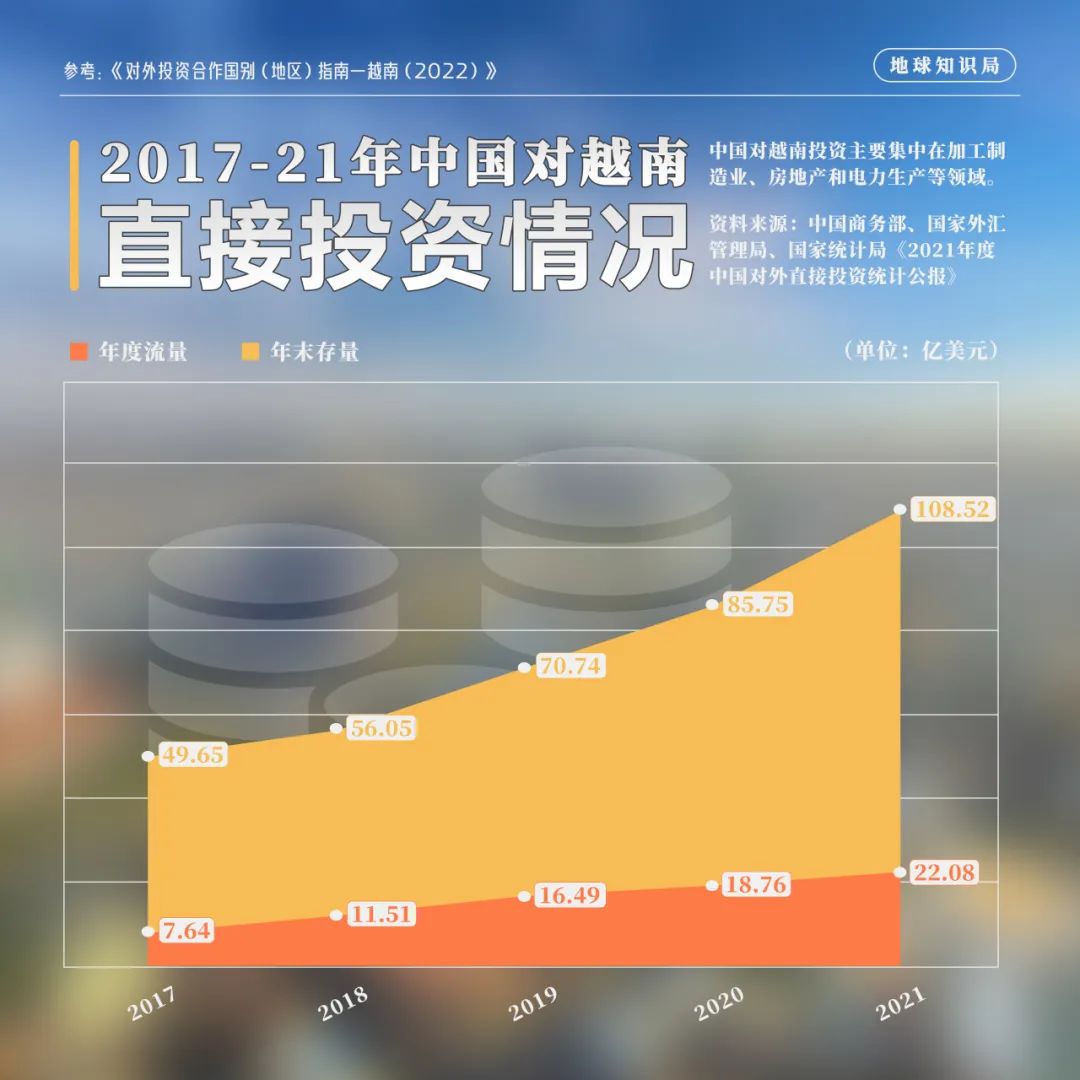
In 2022, China invested US$1.7 billion in Vietnam, which was the 13th largest outward FDI flow from China in that year; by the end of 2022, China's stock of FDI in Vietnam amounted to US$11.66 billion, which was the 17th largest.
Since 2023, Chinese investment in Vietnam has increased even more dramatically, according to Vietnam's Ministry of Planning and Investment: in the first nine months of 2023, Chinese firms injected US$2.92 billion in direct investment into the country, almost double the amount of the previous year; in addition, Hong Kong, China, invested as much as US$5.2 billion (much of which was also "borrowed" by mainland capital). "Hong Kong).
▼
And all this, in addition to the natural economic reasons for the development of China and Vietnam themselves, is also related to the promotion of the external international environment in recent times.
With China's industrial restructuring in recent years, especially in the context of the trade dispute between China and the United States, some Chinese enterprises have increased their investment in overseas investment places. ASEAN countries, represented by Vietnam, have become an important destination for China's industrial transfer, especially for labor-intensive industries.
Vietnam receives Chinese investment mainly in the manufacturing industry, such as textile, furniture manufacturing, electronics manufacturing, photovoltaic industry and power production.
Workshop production line of a manufacturing plant in Vietnam

But in fact, due to the decline in the export market, the domestic upstream raw material costs and labor and other factors such as rising prices of factors of production, Chinese enterprises have long been in more than a decade ago began to open factories in Vietnam, when the U.S. and China were still the economic "honeymoon period".
After 2005, Chinese textile companies such as Blum Oriental and Tianhong Textile have begun to set up garment processing factories in Vietnam, while fabrics continue to rely on the domestic market.
Chinese textile giant Tianhong Group invested about $300 million in 2006 to set up Tianhong Inze Textile Co., Ltd. in Inze Industrial Zone, Dong Nai Province, Vietnam, to produce combed and combed cotton yarns, spandex core yarns, and vortex spun viscose yarns, etc., which are sold back to China and exported to other international markets.
Qingdao Jifa Group invested 5 million dollars in 2005 to set up Thanh An Garment Company in Tran Phuong District, Tay Ninh Province, Vietnam, focusing on the production of knitted garments.
Workers at work in a textile factory in Vietnam

Chinese furniture enterprises have also actively entered Vietnam: in 2013, Chinese furniture manufacturer A Family Furniture established a 450-acre raw material production base in Vietnam, followed by a succession of furniture enterprises to Vietnam; Minhua Holdings, Yongyi Stock, Markor Home Furnishings, Gujia Home Furnishings and other large-scale Chinese furniture enterprises have invested in Vietnam to set up factories.
Workers are busy in the workshop of a furniture factory in Vietnam

After 2018, the transfer of Chinese enterprises to Vietnam accelerated due to factors such as trade friction between the US and China, and industries such as electromechanical products and electronic assembly began to move to Vietnam, in addition to textile and furniture industries.
Some multinational enterprises have implemented the so-called "China+1" strategy, Samsung, Nokia, Intel, Foxconn, PEGATRON, Wistron, Lego and other global giants are increasing their investment in Vietnam, and a number of Chinese enterprises supporting these enterprises have also begun to invest and set up factories in Vietnam.
Inside Intel's Vietnam Factory (Photo: Intel)▼

For example, China's precision manufacturing company Luxun Precision has invested billions in Vietnam in recent years to set up factories, making full use of Vietnam's labor costs, tax incentives and its location-related advantages to reduce the company's production costs and enhance the company's competitiveness. At the same time, further improve the company's overseas strategic layout, to avoid and reduce the impact of the international trade situation.
Another important industry in which Chinese enterprises have invested in Vietnam is the photovoltaic (PV) industry. since 2014, Chinese PV enterprises such as Trina Solar, JAO Technology, LONGi Green Energy, JinkoSolar, Atlas, and Oriental Sunrise have invested in Vietnam and clustered to form PV industry clusters in the north of the country, and Vietnam has become one of the main destinations for Chinese PV enterprises to go overseas.
Vietnam - Ninh Thuan Province, wind + PV project somewhere

While Chinese enterprises are developing themselves
It also brought industrial parks and infrastructure to Vietnam
In terms of industrial parks, Chinese enterprises have also set up six industrial zones in Vietnam, including the Suzaka Export Processing Zone, Long Jiang Industrial Park, Shenzhen-Haiphong Economic and Trade Cooperation Zone, Tianhong Haihe Industrial Zone, Renhui Kangyang Industrial Park and Beijiang International Logistics Industrial Park.
Among them, Long Jiang Industrial Park officially passed the assessment of the Ministry of Commerce and the Ministry of Finance in September 2011 and became a state-level overseas economic and trade cooperation zone.

Vietnam is also an important engineering contracting market for China in ASEAN. In recent years, Chinese-funded enterprises have undertaken a number of large-scale transportation, electric power, new energy and other engineering projects in Viet Nam through international bidding or investment, and the overall progress has been smooth.
The Hanoi Light Rail Line 2 project constructed by China Railway Sixth Bureau Group; the Haiyang Power Plant project invested and general contracted by China National Energy Construction Corporation (CNEC) in cooperation with Malaysia; the Vinh Tan Phase I Coal-fired Power Plant project constructed by a joint venture of three enterprises, namely China Southern Power Grid Corporation (CSG), CLP Power International Corporation (CLPIC), and Vietnam Coal & Mineral Industry Group (VCMIG); and the Yudin solar power station of Vietnam, which was assisted by China National Power Construction Corporation (CECC) for financing and general contracting; and so on.
Hanoi Light Rail Line 2 (Photo: shutterstock)▼

Although Vietnam as the representative of ASEAN on China's exports to form a certain "substitution effect", but need to see is that China and Vietnam and other ASEAN countries are also very strong complementarity, China and Vietnam, the two countries' industrial chain, supply chain depth integration.
In 2021, Vietnam's imports from China will reach US$109.8 billion. In recent years, with the deepening of economic cooperation between the two countries, a "transnational industrial chain" is being formed, and the integration of the industrial chain and supply chain can promote the common development of the two economies.
▼

Investing in Vietnam also requires safety!
It is important to note that investing in Vietnam is not only about opportunities, but also about the many challenges that lead to risks for some Chinese companies investing in Vietnam.
Despite close economic ties, some economic bills between China and Vietnam have been blocked by locals due to some historical and practical issues, such as parts of the Law on Special Administrative and Economic Units of Vung Tum, North Vung Phong and Phu Quoc (draft) to be considered by the National Assembly of Vietnam, which has led to a hold-up.
It's important to do your homework beforehand ......
(Photo: shutterstock)▼

The legal risks of investing in Vietnam are also increasing. In recent years, Viet Nam has been introducing laws on intellectual property rights, environmental protection, competition and data management, to which foreign companies may be exposed.
A revised cybersecurity law, such as the one requiring all foreign entities to store and host data in Vietnam, could increase costs and compliance risks. Of course, there is no excuse for each sovereign nation to have its own national data management rights.
Since the other country has proposed a relevant law, the enterprises concerned must comply with it, and they have to pay the costs. However, the key lies in whether the law is abused in the process of enforcement or whether some "unwarranted" operations are carried out, as well as in the process of the Vietnamese law enforcement operation itself.
A view of the streets of Ho Chi Minh City (Photo: shutterstock)▼

In addition, the new Vietnamese Law on Environmental Protection in 2021, which expands the scope of application and increases administrative approvals, etc., will also have an impact on businesses. This situation, in fact, is similar to the aforementioned cybersecurity law.
Vietnam's investment policies are also constantly being adjusted, posing risks to businesses investing in the country.2023 In November, Vietnam's National Assembly approved the strengthening of the Global Minimum Tax (GMT), which taxes multinationals.
From January 2024, a minimum effective corporate tax of 15% will be levied on enterprises of a certain size. Due to Vietnam's favorable policies, the tax rate of many foreign enterprises was previously considered to be controlled below 15%, and the advantage in terms of tax system will be weakened in the future.
Hanoi at night with neon signs (Photo: Reddit)▼

Chronic power shortages are also a problem, and compared to China, Vietnam's infrastructure is still quite weak, with severe power shortages in particular.
For example, in the summer of 2023, when Vietnam was hit by high temperatures and the authorities made requests to conserve electricity, some factories of Apple's suppliers, such as Hon Hai and Lucent Precision, and Samsung's factories in Vietnam received notices of power cuts or reductions, which at one time affected the production of the companies.
Conserve electricity and keep only essential lighting

Even more, Intel has shelved its investment plans for Vietnam because of the lack of electricity.
Vietnam urgently purchased electricity and power generation equipment from China to make up for the shortage.
In the long run, poor infrastructure is an important constraint on industrial development in many developing countries. In addition, shortcomings in Vietnam's administrative strength are also an important factor constraining investment in Vietnam. Anyone who has been to Vietnam and passed through Vietnamese customs may be able to empathize with this.


 English
  简体中文
简体中文  香港中文
香港中文  日本語
日本語  Español
  Português
  Français